
My Child is Struggling to Attend
When children feel unable to attend school, it can feel overwhelming for families. This article offers a reflective, relational way of thinking about emotionally based school non-attendance.
Matthew Coxon · Published 15 August 2026 · Reviewed 15 August 2026
Key takeaways
- EBSNA is usually a sign of emotional overload, not defiance
- Your calm, steady presence is one of the most powerful tools you have
- Focus on what you can control: your response, routines, and boundaries
- Small relational shifts at home help create safety and predictability
- Clear, warm boundaries reduce your child's sense of being out of control
- Progress is rarely linear; celebrate small, meaningful steps
- Language matters: prefer "struggling to attend" over "school refusal"
- Educational psychology support helps build a shared understanding and a graded plan
When children feel unable to attend; it can feel overwhelming for families. If your child becomes unable to attend school because of anxiety or emotional distress, parents often find themselves caught between concern for their child, pressure from school systems, and uncertainty about what to do next. As an Educational Psychologist, I want to offer a reflective, relational way of thinking about this challenge.
What might be going on beneath my child's struggle to attend school?
When a child is experiencing EBSNA, their behaviour is usually a sign of emotional overload rather than defiance. Many children describe feeling frightened, overwhelmed, or physically unwell at the thought of school. Anxiety, sensory sensitivities, peer difficulties, perfectionism, or past negative experiences can all contribute. There may be a series of factors that push the child away from school, or pull them to the home.
Your child is signalling that something in their school experience feels too difficult right now. When we understand this, we can respond with compassion rather than conflict. It will be important to consider your locus of control; I cannot make my child go to school; I can control how I respond.
What can support them through this?
Your presence is one of the most powerful tools you have. Children in distress need adults who feel steady, attuned, and emotionally available. This does not mean fixing everything instantly; it means showing your child that you are alongside them, even when things feel hard.
In practice, this looks like staying close, listening with curiosity, and offering reassurance through your tone and body language. When your child senses that you are with them rather than pushing against them, their emotional load reduces. This relational foundation is essential before any practical steps can be taken.
What can I actually control in this situation; and how do I hold onto it?
Parents often feel powerless when school attendance becomes a struggle. But you do have areas of influence, and identifying them can help you feel more grounded.
You cannot control your child's anxiety spikes or their immediate readiness to attend school. But you can control your own responses, the routines you maintain, the boundaries you hold, and the way you communicate with school. Holding these calmly and consistently, without escalating, arguing, or withdrawing, helps your child feel anchored.
This is not about exerting force. It is about offering steady leadership: "I am here, I am calm, and I am not giving up."
What can I do at home to make things feel safer and more predictable?
Small relational shifts at home can make a significant difference. Keeping mornings calm and predictable, reducing conversations about school during peak anxiety moments, and celebrating small steps all help create a sense of safety. When your child is stressed, try little things like reducing the amount of words you use, and using a calm and soothing voice.
It is also important to maintain family routines even if school attendance is disrupted. This communicates that life continues, that structure remains, and that your child is still part of the rhythm of the household.
How do I hold boundaries without increasing pressure?
Children experiencing EBSNA often feel out of control. Clear, warm boundaries help them feel safer. This might sound like:
- "I will not argue with you, but I will stay with you."
- "I hear that school feels scary. I am not going to force you, but I will help you take small steps."
- "I am here, and we will get through this together."
This blend of calm firmness and compassion helps your child feel supported rather than pushed. It also models emotional regulation and steady leadership.
How do I work with school in a way that supports my child?
You should not carry this alone. Schools have a responsibility to collaborate and adapt. Ask for a graded plan that is adjusted to your child's current capacity. Schools should consider some of the following: a named adult your child can connect with, safe spaces, predictable routines, and flexibility around transitions.
Your role is to maintain presence and encouragement at home while school adjusts the environment to meet your child's needs. When home and school work together, children feel held by a wider network of support.
What does progress look like; and how do I recognise it?
Recovery from EBSNA is rarely linear. Progress often comes in small, meaningful steps: getting dressed, sitting in the car, walking to the gate, entering the building for a short period. Each step builds confidence and reduces avoidance.
It is important to notice and celebrate these moments. They show your child that effort matters and that change is possible.
How do I look after myself through this?
Supporting a child with EBSNA is emotionally demanding. You may feel guilt, frustration, fear, or exhaustion. These feelings are normal. You are doing your best, and your child is not choosing this struggle.
Remember that connection is more powerful than control. Your steady presence, your willingness to stay alongside your child, and your ability to hold calm boundaries are the most important tools you have.
A note on language
You may hear terms such as "school refusal" or "truancy". These phrases can feel blaming and may suggest that the child is choosing not to attend. I prefer to use language such as emotionally based school non-attendance, barriers to attendance, or a child struggling to attend. This helps us stay curious about what is making school feel difficult, rather than focusing only on the behaviour we can see.
How might educational psychology support help?
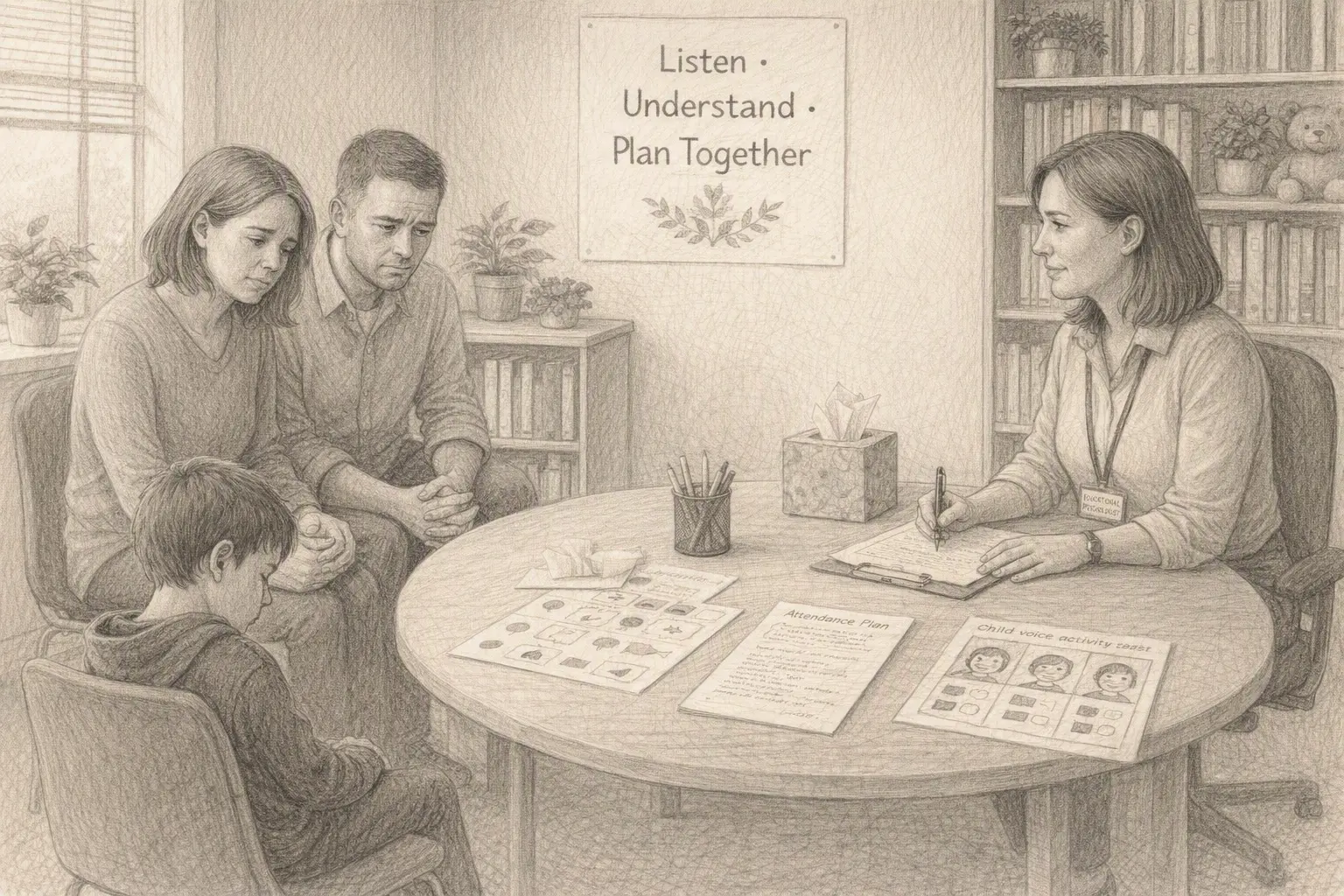
Educational psychology support can help families and schools move from feeling stuck to developing a shared understanding of what is happening for the child. This often begins with consultation: listening carefully to parents and carers, gathering views from school, and thinking together about the pattern of the difficulty. The aim is not to blame the child, family, or school, but to understand the problem more clearly.
Where appropriate, I would seek to understand the child's voice in a way that feels safe and manageable for them. This might include conversation, drawing, scaling activities, sorting tasks, or other assessment activities that help the child communicate what feels hard, what helps, and what they would like adults to understand. This can be especially important when a child finds it difficult to explain their feelings directly.
The next step is usually to work together to build a realistic attendance plan that can be shared with school. This plan should start from the child's current level of capacity and identify small, achievable steps towards increased attendance or engagement. It may include adjustments to the school environment, a trusted adult, reduced demands at key points of the day, planned safe spaces, flexible transitions, and clear communication between home and school.
Next steps
If you would like to talk something through, you can book a free 30-minute conversation or read more about the educational psychology services on offer.
This page provides general educational information. It is not a diagnosis, and it is not a substitute for individual assessment or professional advice about a particular child or young person.